 In rural America, the last mile of care is a person. It’s the community health worker who drives an hour to sit at a kitchen table, helps a neighbor make sense of a Medicaid renewal notice, or arranges a ride to the specialist two counties away.
We celebrate that integral community health work all year round, but especially on National Rural Health Day, November 19. We also want to name a hard truth: much of it is still funded one grant cycle at a time. When the grant ends, so does the program, and so does the trust it took years to build.
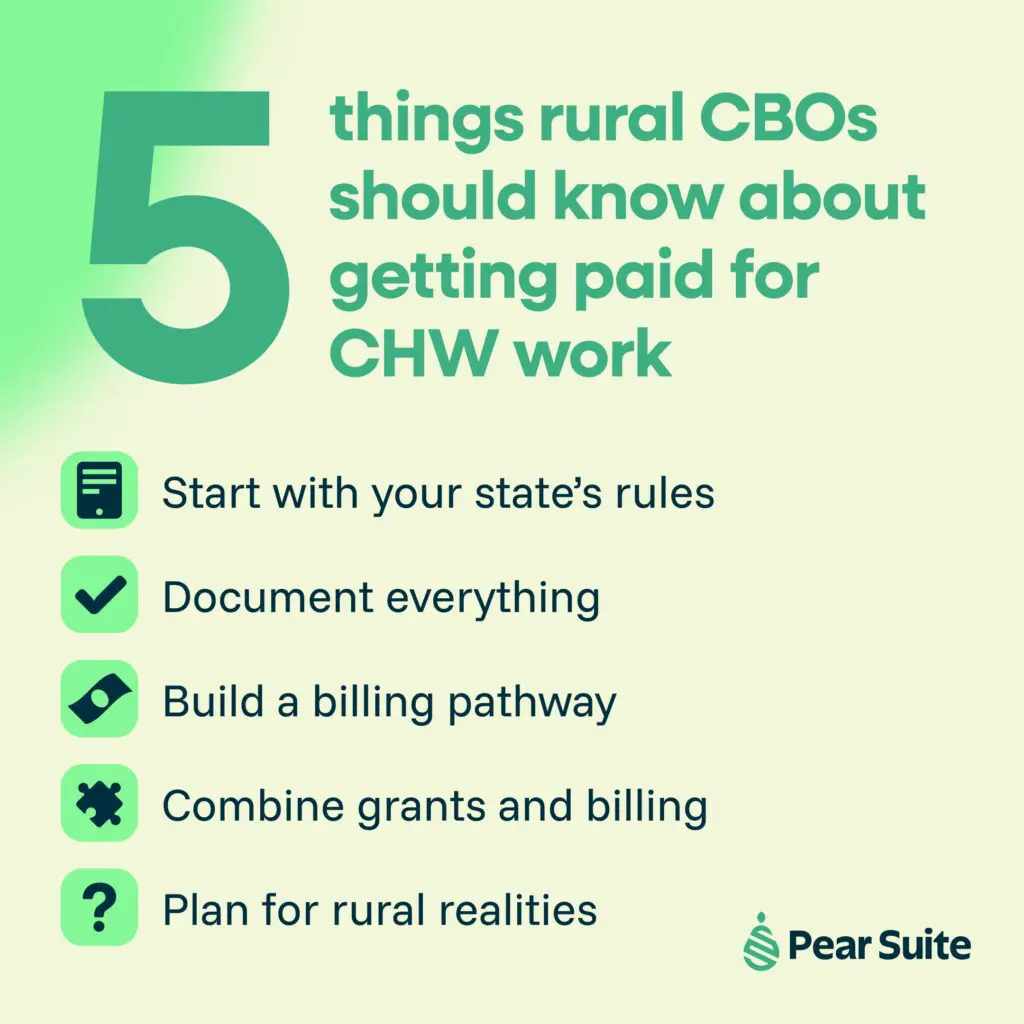
It doesn’t have to be that way. A growing number of states now reimburse CHW services through Medicaid, and Medicare reimbursement is already available nationally through Community Health Integration (CHI) codes. Here are five things rural community-based organizations (CBOs) should know about getting paid for the work they already do.
1. Start with your state’s rules
There is no single national CHW benefit for Medicaid beneficiaries. Many state Medicaid programs define who qualifies as a CHW, which services are covered, and what training or certification is required. Many also require a licensed provider to recommend services, or limit visit types and hours.
Roughly half of states now pay for CHW services through Medicaid, but they take different routes: a state plan amendment, an 1115 waiver, or managed care contracts. That last route can mean each health plan in your state sets its own rules. Look closely at the details that shape a rural program, like how time is billed, caps on visits per client, and whether services need an order from a physician or other licensed provider. If your state doesn’t reimburse yet, watch for pending legislation, and connect with your state CHW association or coalition, which often tracks what’s coming.
Read your state’s policy first, then design your program around it.
2. Documentation is what gets paid
CHWs do a remarkable amount of work that never shows up anywhere: the follow-up call, the ride arranged, the referral that finally stuck. If it isn’t documented with the right detail, it can’t be billed or reported to funders. Capture every interaction, its purpose, and the time spent, ideally as it happens rather than at the end of a long day on the road.
In practice, a billable progress note typically captures who you served, the service provided, the date and time spent, the goal in the client’s care plan it supports, and any referral or follow-up. Your state and health plans set the exact requirements. Payers can audit claims after paying them, so notes reconstructed from memory days later are a real risk, and missing details can mean paying money back, or worse. Good documentation also does double duty: the records that support a claim also show funders and health plans what your program achieves, such as referrals completed and appointments kept, and that evidence helps you renew a contract or win a new one.
3. You need a billing pathway
“One of the greatest strengths of rural communities is the willingness of people and organizations to come together to support their neighbors. However, we cannot continue to rely solely on the generosity of volunteers, short-term grants, and the determination of a few passionate individuals to meet the growing needs of our communities,” says Wendy Bailey, a certified CHW in rural Indiana and the owner/founder of Empowering With Passion Consulting. “Community health workers are doing essential work every day, much of which goes unseen, undocumented, or uncompensated. The phone calls, follow-ups, resource navigation, advocacy, and time spent building trust are all part of improving health outcomes, even when they don’t fit neatly into a traditional healthcare billing model.”
Getting paid usually means enrolling as a Medicaid provider, contracting with managed care plans, or partnering with a clinic, FQHC, or hospital that bills on your behalf. CHW services that address unmet social or environmental needs affecting a patient’s ability to access care are typically paid under Medicare CHI codes through a partnering billing practitioner, such as a physician, nurse practitioner, or physician’s assistant. Each route has trade-offs in control, revenue, and administrative burden.
Enrolling directly gives you the most control and keeps the full reimbursement, but it also means handling credentialing, claims, denials, and compliance yourself, which is a lot for individuals and small teams. For many CHWs and CBOs, partnering with a clinic or hospital works because it means access to needed software and administrative infrastructure, with payment upon completion of an agreed-upon scope of work. A third option is to join a community care hub that already holds health plan contracts and handles billing, so a small rural team can start billing without building a back office from scratch.
4. Braid funding instead of replacing it
Grants still matter. They cover start-up costs and work Medicaid won’t pay for, like community events, transportation, and broad outreach. Reimbursement covers eligible services. Together, they make a program last.
Rural organizations have a new opportunity here. The federal Rural Health Transformation Program (RHTP) is sending $50 billion to all 50 states from 2026 through 2030, and states such as Kansas and Wisconsin are planning to direct some of it to CHW programs. But the money is time-limited. Use it to build lasting infrastructure, not just to fill a budget gap for five years. RHTP proposals specifically require that applicants have a sustainability plan, which is an opportunity to empower this workforce, rather than a burden.
“Passion alone cannot sustain this work,” Bailey notes. “We need sustainable funding, fair compensation, opportunities for professional growth, and systems that recognize the true value of CHWs. We also need to be included in conversations where decisions are made about healthcare delivery, community resources, and funding. Those of us doing the work on the ground bring a perspective that cannot always be captured through numbers or reports alone.”
5. Plan for rural realities
Long drives, small teams, and patchy connectivity shape everything about rural CHW work.
“We have to recognize that rural healthcare does not look the same as healthcare in larger communities,” Bailey says. “Our patients may live miles from the nearest provider, have limited internet access, lack reliable transportation, or face challenges that require creative solutions and strong community partnerships. CHWs understand these challenges because we live, work, and serve in the same communities as the people we support.”
Assume the signal will drop. More than a quarter of rural adults still don’t have home broadband, and cell coverage on back roads can vanish for miles. Many CHWs carry mobile hotspots, sometimes on two carriers, and stop at a library or clinic to upload notes between visits.
Satellite is changing the map. In Alaska, where many villages are off the road system, a 2023 federal tribal broadband grant funded Starlink service for more than 1,400 homes in the Yukon-Kuskokwim Delta. A satellite connection at an office or community hub can become the place CHWs sync records, train, and join video calls.
Connect clients, too. In North Carolina, CHWs lent mobile hotspots to farmworkers for the season so they could join medical and mental health video visits. CHWs can also help eligible households enroll in Lifeline, the federal phone and internet discount.
Know your phone and video rules. Many state Medicaid programs cover some audio-only care, but rules vary and don’t always extend to CHW services. For a client without broadband, a phone call may be the only realistic follow-up, so in-person-only rules hit rural programs hardest.
Budget for the drive, and protect your people. Travel time is rarely billable, but track it anyway; it makes the case to grant funders and helps you size caseloads to the geography. Set check-in routines for CHWs who work alone, and choose mobile-friendly tools that cut paperwork, so your CHWs spend their time with people, not forms.
Keeping the last mile open
Rural CHWs have always found a way to show up. The job of funders, payers, and partners is to make sure the systems behind them show up, too.
Pear Suite helps community-based organizations document, bill, and sustain CHW programs in one platform, so the work is visible, and the funding lasts beyond the next grant cycle. If you’re building or growing a rural CHW program, let’s talk.
This National Rural Health Day, thank a community health worker. Then help make sure they’re still there next year.