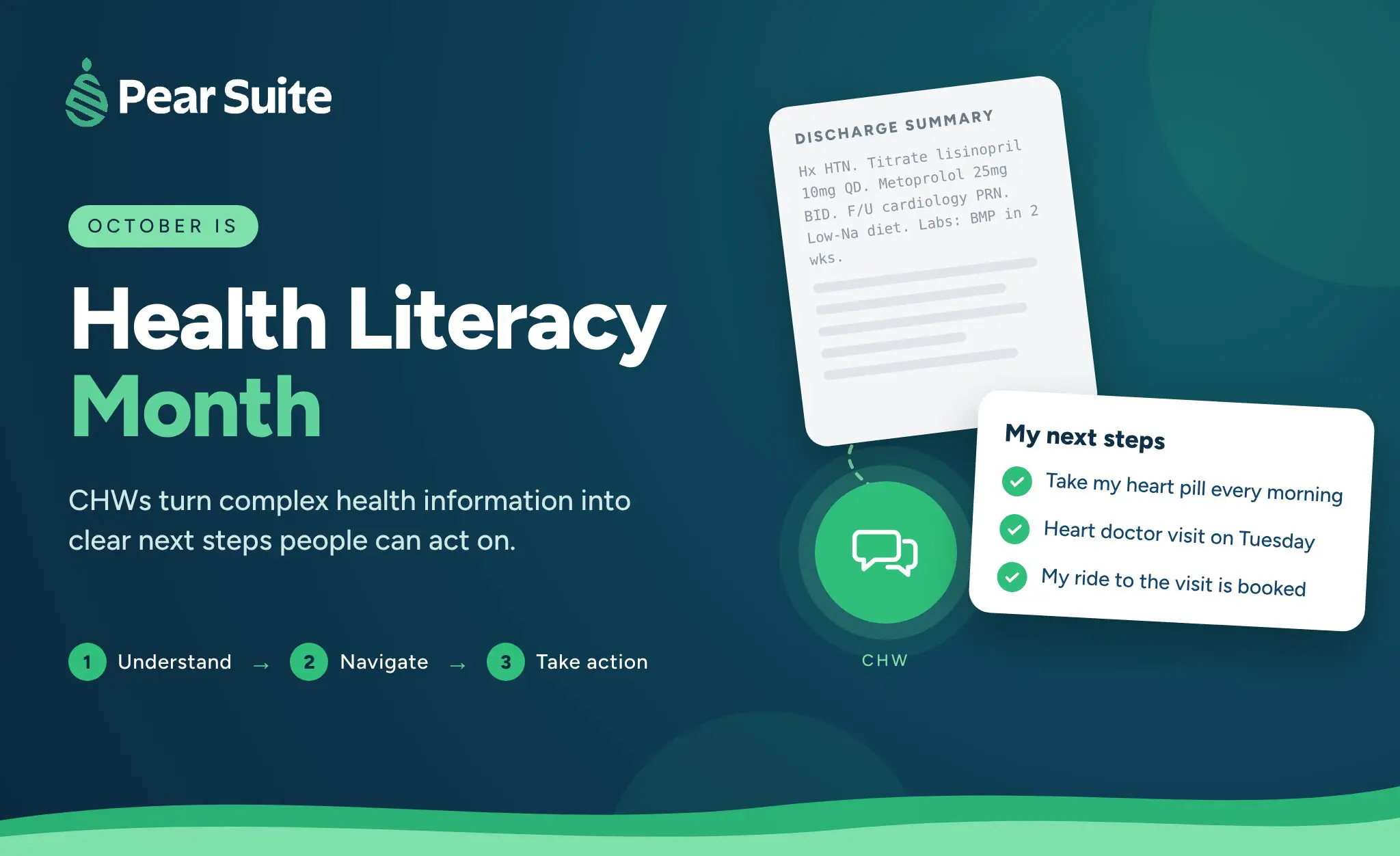
October is Health Literacy Month, a reminder that people need more than access to health information; they need information they can understand and use. Making that happen takes more than clearer handouts and simpler forms. It takes people who can help turn information into action, and community health workers (CHWs) are among the most important of them.
More than understanding medical information
When a patient leaves an appointment with instructions to schedule a specialist, change a medication, apply for transportation, follow a new diet, and complete paperwork for a benefit program, the clinical encounter may be over. Still, turning that plan into action is just beginning. That is where health literacy becomes more than the ability to read a discharge instruction or understand a diagnosis.
Health literacy also depends on whether the healthcare system makes information understandable, actionable, and navigable. The Office of Disease Prevention and Health Promotion now explicitly recognizes organizational health literacy alongside individual health literacy, acknowledging that people can struggle when health systems and digital tools are unnecessarily complex. CHWs often witness those obstacles up close.
The challenges and opportunities are somewhat universal no matter the state, but the approach to handling health literacy can vary by the CBO or even the individual community health worker.
“In Kansas, we teach CHWs not simply to give someone information, but to help people understand it, feel confident using it, and take practical steps to improve their health,” explained Treva Smith, Executive Director of the Kansas Community Health Worker Coalition and a certified CHW instructor who has trained the community health workforce across Kansas and Missouri.
CHWs as healthcare translators
CHWs translate not simply between languages, but between systems, cultures, institutions, and lived experience. A provider may explain a treatment plan. A discharge summary may list the next steps. A patient portal may hold the test results.
The CHW can help answer the questions that arise afterward:
- What does this actually mean for me?
- How do I get there?
- What happens if I can’t afford it?
- Who do I call?
- What if I don’t trust the system?
- How does this fit into everything else happening in my life?
Because CHWs often live in or come from the communities they serve, they bring context that isn’t always visible in the medical record. They may understand transportation barriers, food insecurity, housing instability, cultural considerations, family dynamics, or distrust of institutions that can determine whether a care plan succeeds. That isn’t ancillary work. It’s care delivery that addresses social drivers of health.
How CHWs build health literacy every day
CHWs strengthen health literacy in ways a pamphlet or portal can’t:
- Plain-language conversations. CHWs explain information in the person’s own language and words, often at the kitchen table where questions actually come up, and check for understanding by asking people to explain it back.
- Hands-on navigation. From benefit applications and Medicaid renewals to patient portals and appointment scheduling, CHWs help people work through the systems they’re expected to use on their own.
- Confidence, not dependence. The goal isn’t for CHWs to do everything for people. It’s to help them ask questions, advocate for themselves, and manage their health over time.
- A feedback loop to the system. CHWs see exactly where instructions, forms, and processes confuse people. When organizations listen, CHWs become a direct line to improving organizational health literacy.
CHWs in health literacy efforts
For health plans and providers, involving CHWs in designing patient materials and workflows, giving them a defined place in care processes, and creating clear handoffs and communication between CHWs and clinical teams creates pathways for improved outcomes.
For CBOs, it means being recognized as partners in the healthcare ecosystem, not simply destinations for referrals. For CHWs, it means having the tools, information, training, organizational support, and sustainable funding to do this work well. And for patients, it means something much simpler: a health care system that makes sense.
Health Literacy Month asks us to make health information easier to understand and use. CHWs do that every day, one conversation at a time. If healthcare wants care plans to become real-world outcomes, it needs people who can bridge the distance between the exam room and everyday life. CHWs are that bridge. It’s time to build them into the care team, not around it.